Physical Address
304 North Cardinal St.
Dorchester Center, MA 02124

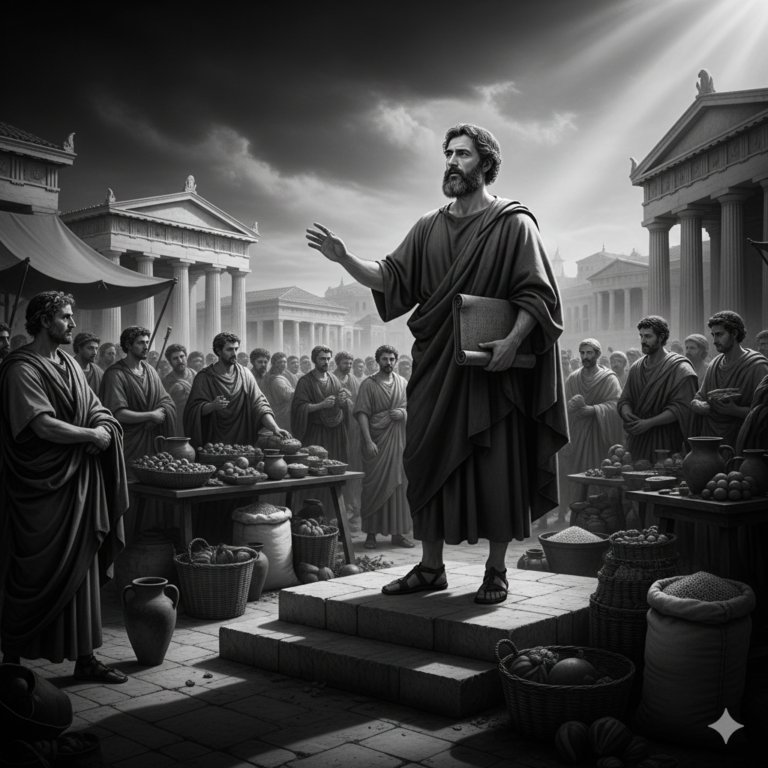
A Light, Modern Look at the Man Behind the Calm**
If Marcus Aurelius is the Stoic superstar and Epictetus is the tough-love coach, then Zeno of Citium is the quiet architect who built the entire system.
He didn’t set out to become a philosopher.
He wasn’t raised in a school.
He wasn’t trained by a fancy Greek family.
Zeno started as a trader.
A merchant.
A guy who literally sold purple dye.
And then — as often happens in philosophy — disaster struck.
His ship wrecked.
He lost everything.
He washed up in Athens with nothing but his thoughts.
And instead of panicking, he walked into a bookstore, picked up a book about Socrates, and said,
“Well… I guess this is my life now.”
From shipwrecked merchant to founder of Stoicism — let’s explore the surprisingly human story of Zeno.
Zeno was born around 334 BCE on the island of Citium (in Cyprus).
He worked in his family’s trading business, taking goods across the Mediterranean.
Then one day — boom — the ship sank.
With no money and nowhere to go, he wandered into Athens and discovered philosophy. He studied under various thinkers:
Then he built his own system, blending:
Eventually he began teaching in the Stoa Poikile — the “Painted Porch” — giving his school the name:
Stoicism
(Not “stove-ism” as some believe.)
He lived simply, taught clearly, and died calmly — very on brand.
Zeno taught that external things — wealth, health, fame, comfort — weren’t truly “good.”
They’re preferred, sure.
But not good in the moral sense.
The only real good?
Virtue.
Meaning:
Everything else is just extra stuff.
Before Epictetus sharpened it and Marcus Aurelius polished it, Zeno invented it:
Some things are up to us.
Some things are not.
You control:
You DO NOT control:
Zeno would have thrived in the age of group chats and social media — mainly by ignoring them.
Sounds poetic, but Zeno meant something practical:
Use reason.
Align with reality.
Don’t fight the world — work with it.
He believed humans are rational beings, and a rational life is a good life.
Zeno didn’t say “don’t feel things.”
He said:
“You feel unnecessary pain when you believe false things.”
This is basically pre-CBT psychology.
Zeno believed humans aren’t isolated individuals — we’re interconnected.
We’re part of a larger community.
Our duty is to others, not just ourselves.
He was the first Stoic to emphasize cosmopolis — the idea that all humans share a universal citizenship.
Because he created the foundation for one of the most useful mental frameworks in history.
Stoicism is everywhere:
When people reference “staying calm,” “controlling reactions,” or “living with purpose,” they’re channeling Zeno — even if they don’t know it.
His ideas help you:
Stoicism survives because it works.
Zeno would say:
“You don’t need much.
You just need to live well.”
Zeno didn’t become a philosopher because life was easy.
He became one because life fell apart.
He lost everything…
…and built something that has lasted over 2,000 years.
His life proves:
Sometimes your greatest philosophy begins where your comfort ends.
Not bad for a shipwrecked merchant.