Physical Address
304 North Cardinal St.
Dorchester Center, MA 02124

A Light and Lively Look at Athens’ Most Famous Question-Asker**
If ancient Greece had a man who could turn every conversation into a pop quiz, it was Socrates.
He didn’t write books.
He didn’t charge money.
He didn’t start a school.
He didn’t travel the world giving lectures.
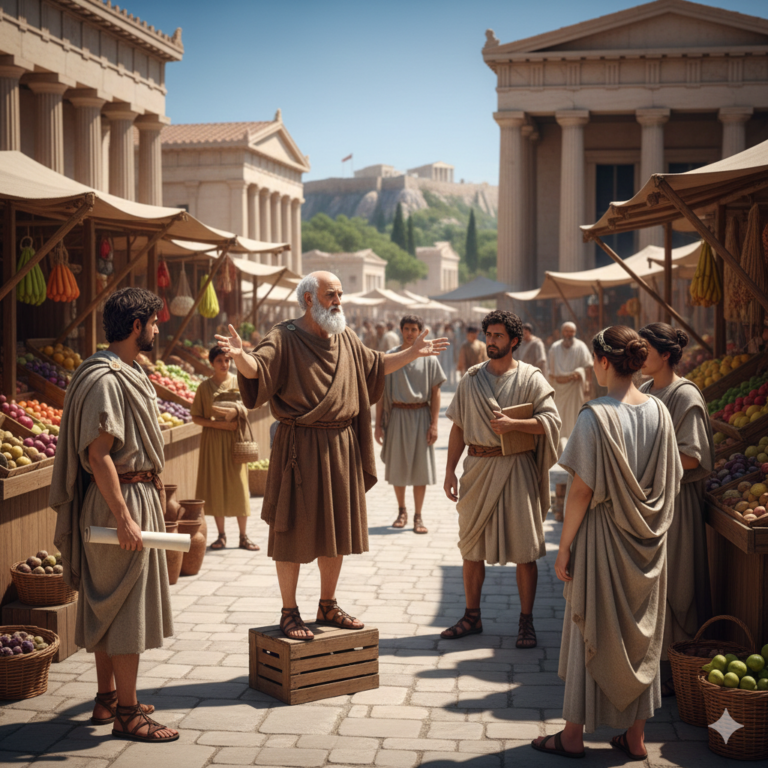
Instead, he wandered around Athens, talking to anyone who would listen—and many who absolutely did not want to listen.
Yet somehow, with no written works and no official title, Socrates became the most influential philosopher in history.
Let’s explore the life, ideas, and occasionally irritating charm of the man who turned questioning into an art.
Socrates was born around 470 BCE in Athens.
He wasn’t glamorous.
He wasn’t wealthy.
He was a stonecutter by trade before turning full-time philosopher.
He spent his days in public spaces:
…talking about virtue, justice, courage, and the good life.
His style was simple:
Ask questions.
Ask more questions.
Keep asking until the other person questions their whole worldview.
This did not always make people happy.
Eventually, Socrates was charged with “corrupting the youth” and “not believing in the city’s gods.” He was sentenced to death and famously accepted it calmly, choosing integrity over escape.
His ideas survive through his students, especially Plato and Xenophon, who wrote down his conversations.
Socrates believed life has meaning only when you think deeply about it.
Not just “live, laugh, love” — but reflect, question, understand.
He wanted people to stop living on autopilot.
His most famous line?
“I know that I know nothing.”
He didn’t mean he was clueless.
He meant that thinking you know everything makes you blind.
Humility is intellectual power.
Socrates challenged:
Not to cause trouble (though he did)…
…but to help people uncover truth through reason.
This became known as the Socratic Method, still used in:
Ask, clarify, examine, repeat.
Socrates believed being a good person matters more than:
He believed a just person is happier than a successful scoundrel.
Twitter would hate him.
Socrates saw philosophy not as a subject, but as a lifelong practice.
Curiosity = virtue.
Complacency = stagnation.
He encouraged students to think constantly, not occasionally.
Socrates feels incredibly modern because he tackled problems we still face:
His approach teaches:
He would have been banned from social media in 10 minutes — and then quoted forever.
Socrates believed wisdom is a habit, not a destination.
Socrates wasn’t wealthy, handsome, or powerful.
He had no office, no institution, no book deals, and no following on Instagram.
All he had was:
He reminds us that wisdom isn’t about knowing all the answers.
It’s about asking the right questions.