Physical Address
304 North Cardinal St.
Dorchester Center, MA 02124

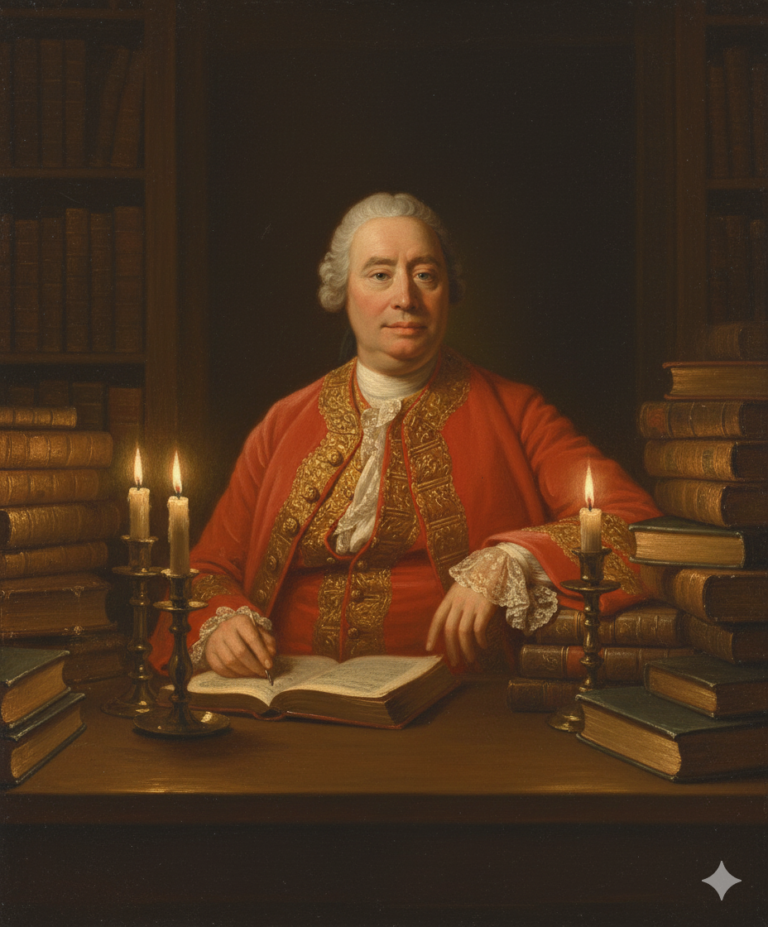
A Light, Modern Look at Scotland’s Master of Skepticism**
If philosophy had a charming gentleman who quietly walked in, smiled warmly, and then—using perfect logic—proceeded to unravel your deepest assumptions…
…it was David Hume.
Hume was the king of calm skepticism.
He didn’t yell, he didn’t argue aggressively, he didn’t set anything on fire (unlike some Greeks).
Instead, he asked simple questions that made people rethink everything they thought they knew.
He was sharp, curious, playful, and astonishingly modern — even though he lived in the early 1700s.
Let’s explore the ideas of the man who made philosophy more empirical, more grounded, and, honestly, much more fun.
David Hume was born in Edinburgh in 1711.
He was supposed to become a lawyer, but instead he became:
He once said his pursuit of philosophy was motivated by nothing more than:
“an insatiable curiosity.”
He was gentle, polite, and famously fond of good food — especially sweets and wine — which makes him instantly relatable.
Despite writing some of the most important works in Western philosophy, he struggled to get academic jobs because universities feared his skepticism would get them in trouble.
So he did what any good philosophy overachiever does:
He kept writing anyway.
Hume believed humans make a lot of assumptions, especially about:
And most of those assumptions aren’t based on reason — they’re based on habit.
This wasn’t meant to crush your spirit.
Just to humble your certainty.
Hume believed that all knowledge comes from experience — not from pre-built ideas or innate truths.
You learn through:
He basically predicted modern psychology and neuroscience 200 years early.
This is Hume’s famous “uh-oh” moment.
He noticed that just because two things always happen together doesn’t prove one causes the other.
You only believe they’re connected because your brain likes patterns.
This insight STILL makes scientists nervous.
Hume looked inside his mind and found not a stable “self,” but a bundle of:
All constantly changing.
Buddhism: “The self is an illusion.”
Hume: “Same, bro.”
Hume believed emotions come first, and reason comes second.
You think you’re being logical…
…but you’re often just justifying what you already feel.
Modern cognitive science?
Exactly the same conclusion.
Hume rejected rigid moral systems.
He believed humans naturally feel empathy, compassion, and approval for kindness.
We don’t derive morality from logic —
we FEEL it.
This was revolutionary.
Because he predicted:
Long before anyone else.
He teaches:
Skepticism for Hume wasn’t negativity —
it was intellectual honesty.
Hume’s philosophy isn’t about destroying beliefs —
it’s about making them stronger through clarity.
Hume wasn’t loud.
He wasn’t dramatic.
He didn’t form a cult, start a school, or get himself executed.
He lived quietly, wrote brilliantly, and changed philosophy forever.
He reminds us:
“Be curious.
Be kind.
Be skeptical — but not cynical.
And always check your assumptions.”
Not bad for a man who preferred a quiet study and a good dessert.